近年来,随着风电叶片尺寸的不断增大,复合材料叶片的结构强度和破坏问题愈发重要。为了减少叶片局部屈曲、叶根过渡段失效、承力梁帽分层等破坏模式对叶片结构安全性和可靠性带来的潜在威胁,中国科学院工程热物理所研究人员在不损失叶片气动性能的前提下,提出了大厚度钝尾缘叶根、大厚度叶中、阶梯厚度承力梁帽等创新结构设计概念;并利用非线性有限元数值分析方法和全尺度叶片弯曲承载力破坏试验,系统地分析了新型叶片在极限弯曲荷载下的结构响应特征,全面验证了结构设计方法在提升复合材料叶片极限强度和抑制局部非线性屈曲的有效性,指出了该方法应用于大型、超大型风电复合材料叶片的可能性。研究成果成功应用于一款100kW风力发电机组,截至目前,后续各项现场实测工作正在稳步开展。
研究成果已在Proceedings of the ASME 2014 International Mechanical Engineering Congress & Exposition和Journal of SCIENCE CHINA Technological Sciences正式发表。研究工作已被选入期刊封面故事(Cover Story),研究论文成为期刊热门文章(Hot Paper)。
论文链接: http://tech.scichina.com:8082/sciEe/EN/Y2015/V58/I1/1
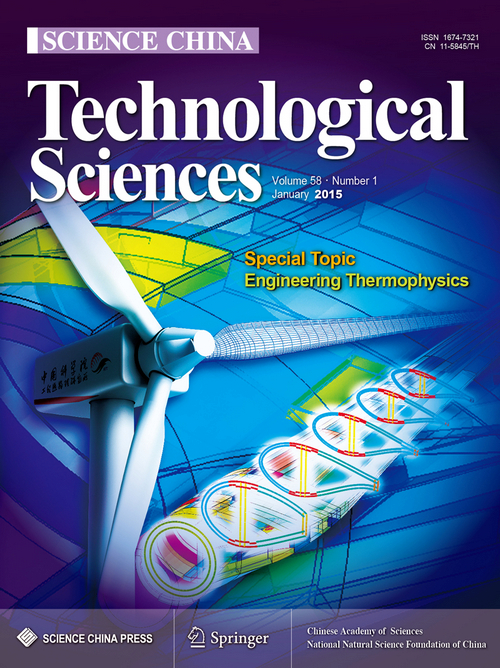
Cover Image: IET-Wind proposes new structural features to increase strength of composite wind turbine blades
Cover Story: In recent years, as blade sizes increase, structural strength and failure of wind turbine blades have become more critical. To reduce the risk of blade failure in the main modes associated with local buckling, root transition region failure and spar cap delamination, IET-Wind have proposed new structural features including a flatback design for the inboard section, thick airfoils for the inboard and mid-span sections, and transversely stepped thickness in the spar caps. These features improve structural performance of composite blades without compromising their aerodynamic efficiency. On pages 1–8, using finite element analysis and static bending test, Chen Xiao and co-workers describe their detailed and thorough investigation of the structural response and characteristics of their modified wind turbine blades, which have been successfully incorporated and field tested on a 100-kW wind turbine. The research shows that the proposed structural features hold great potential in strengthening large composite wind turbine blades.